Congratulations to Matthew Werneken, CC-SEAS'25 on being named a 2026 Hertz Fellow!
The Hertz Foundation has announced 19 recipients of the 2026 Hertz Fellowship in the applied sciences, engineering and mathematics. The Hertz Fellowship provides financial and lifelong professional support for the nation’s most promising graduate students in science and technology.
The fellowship includes up to five years of funding, valued at up to $250,000, and the freedom to pursue innovative projects wherever they may lead. In addition, fellows take part in ongoing mentoring, symposia, and workshops with our vibrant community of more than 1200 fellows, a set of peers who span disciplines, generations, and geography.
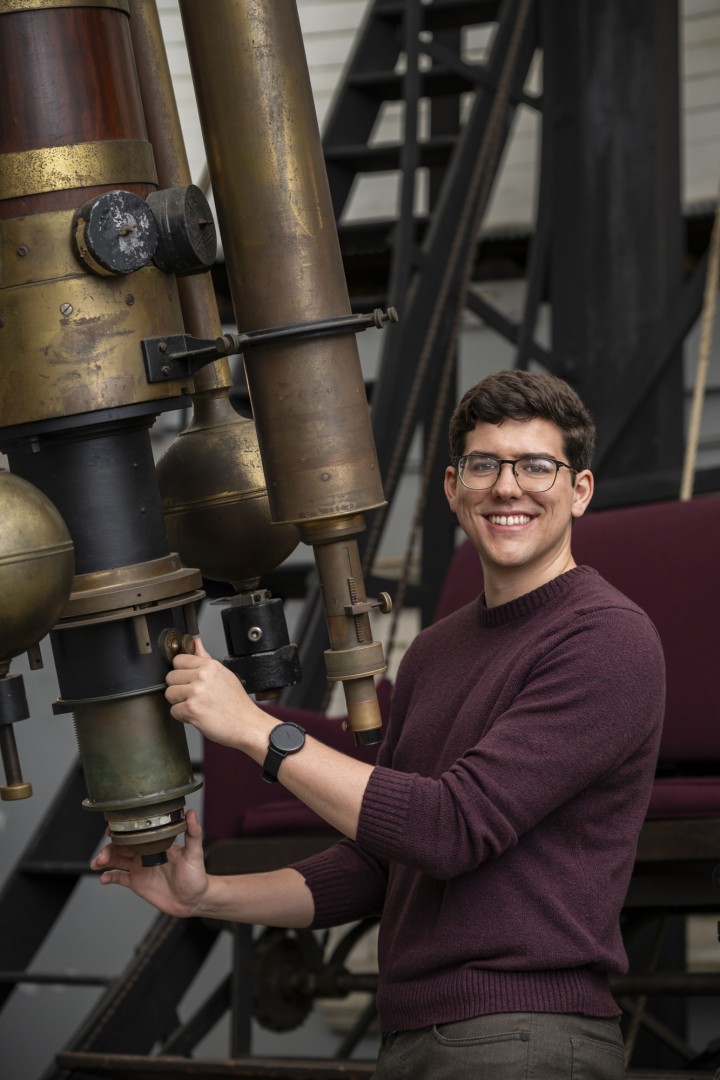
Matthew Werneken CC'25
Matthew is currently an astronomy doctoral student and NSF Graduate Research Fellow at the Center for Astrophysics | Harvard & Smithsonian, where he works on both astrophysical instrumentation and observational surveys to study the environments of the Milky Way galaxy and its neighbors. He aims to use this dual focus in designing the next generation of observatories on ground and in space, to solve the mysteries behind how galaxies form and evolve. He is currently working on a major new survey to map the cold gas in the halo of our galaxy and set constraints on the distribution, mass, and temperature phases of this “circumgalactic medium”. He is also supporting the design and build of an accompanying high-throughput spectrograph, which will be a cornerstone tool in measuring astrophysical transients after it is commissioned in 2027.
For more information about the Hertz Fellowship, please visit Undergraduate Research and Fellowships.